BECE 2014 BDT Pre-Technical Skills Paper 2 (Essay) – Answers
June 2014
BASIC DESIGN AND TECHNOLOGY 2
(Pre-Technical Skills 2)
Paper 2 – Essay
ANSWERS
SECTION A
(CORE SKILLS)
1. (a) State the main method for cooking the following foods:
(i) rice – boiling
(ii) cake – baking
(b) State four suitable methods for preserving fish.
Drying
Smoking
Freezing
Salting
Frying
Canning
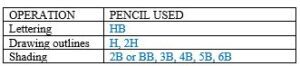
(c) (i) List the type of pencil most suitable for the following operations:
(ii) List four methods of recording data for solving design problems.
Taking notes / Using computer
Taking photographs
Video recording
Audio recording
Drawing / sketching
Drawing graphs
Making charts
(d) (i) State three benefits of packaging.
It adds value to the product
It protects the product from contamination
It protects the consumer from hazards
Attracts consumers
Makes handling easier / makes it portable
Promotes easy identification.
(ii) List two important information on a good package
Information about content / manufacturer
Date of production
Expiry date
Instructions for usage
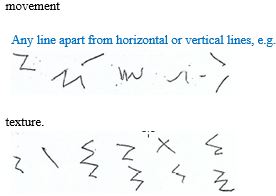
(e) Draw a line to illustrate each of the following:
SECTION B
[50 marks]
Answer two questions only from this section
All questions carry equal marks
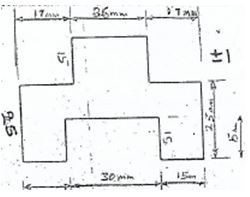
2. Figure 1 shows a wooden object to be prepared in the workshop.
(a) Draw full size the front view in the direction of arrow W.
Accurately drawing 6 horizontal lines and 6 vertical lines neatly
(b) List two tools used for:
(i) marking-out the shape of the object
Marking knife
Pencil
Try-square
Marking gauge
Rule / Tape measure
Straight edge
(ii) cutting the waste wood.
• Mortise chisel or firmer chisel
• Mallet
• Tenon saw / other back saws (except rip saw)
(c) State two ways of caring for and maintaining the jack plane.
Cleaning the tool after use
Oiling the metal parts
Keeping the tool in the rack or tool box
Sharpening the tool before use
(d) State the difference between ferrous metals and non-ferrous metals.
Ferrous metals are metals that contain iron while non-ferrous metals do not contain iron.
Ferrous metals can rust while non-ferrous metals do not rust.
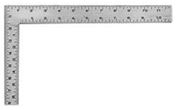
(e) Make a freehand sketch of the builder’s square.
3. (a) State one reason why personal safety should be observed in the workshop.
To avoid injury
To prevent accident
(b) List two specific tools for carrying out each of the following operations:
(i) setting-out a wall;
Line and pins
Straight edge
Builder’s square
Profile Boards
Spirit Level
Tape measure / surveyor’s tape
Pegs
Piece of chalk
(ii) moulding bricks;
Mould box
Head pan / gauge box / wheel barrow
Shovel / spade
Tamping rod
Pick Axe
(iii) cutting a tenon from a piece of wood;
Try square
Marking gauge / mortise gauge
Pencil / Marking knife
Tenon Saw
Mallet
Bevel-edged chisel / firmer chisel
(iv) soldering sheet metals.
Soldering iron / bit
Coal pot / stove / blow lamp
File / emery cloth
Shears / pair of snips
Mallet
Folding bar
(c) (i) Make a freehand pictorial sketch of a rasp file
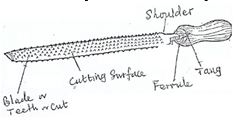
(ii) Label any two parts of the tool sketched in (c)(i) above.
Blade / teeth / cut
Tang
Ferrule
Handle
Shoulder
(iii) State one use of the rasp file.
For smoothening edges and shapes
For shaping a circular piece of wood
(d) (i) State the main difference between a brick and a block.
The size: A block is bigger than a brick
The weight: A block is heavier than a brick
The material: A block is made of concrete whilst brick is made of clay
(ii) List the two main materials for making sandcrete blocks.
Sand
Cement
4. (a) List one protective clothing each for the following:
(i) foot; safety boots / safety shoes / Protective shoes
(ii) head; Helmet
(iii) eyes, Goggles / eye shield / spectacles
(b) (i) Make a freehand pictorial sketch of the firmer chisel.
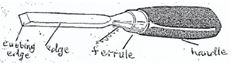
(ii) Label any two parts of the tool sketched in 4 (b) (i)
• Cutting edge
• Edge
• Ferrule
• Handle
(c) State one reason each for carrying out the following operations:
(i) cross-filing
For removing waste metal
For removing unwanted metal
For removing excess metal
(ii) curing a sandcrete block;
To help the block to attain its maximum strength
To prevent rapid drying
To reduce shrinkage
To make it dense
To prevent / reduce cracks
To make it durable
(iii) setting out a wall.
• For straightness
• For squaring
• For accuracy
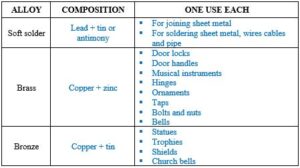
(d) Copy and complete the table below


This is amazing